

Artificial Turf in Texas Heat: What Actually Works
The honest guide to artificial turf in DFW — heat, pets, drainage, and what we install when clients want green in July. Infill technology, pile heights, and real lifespan numbers.
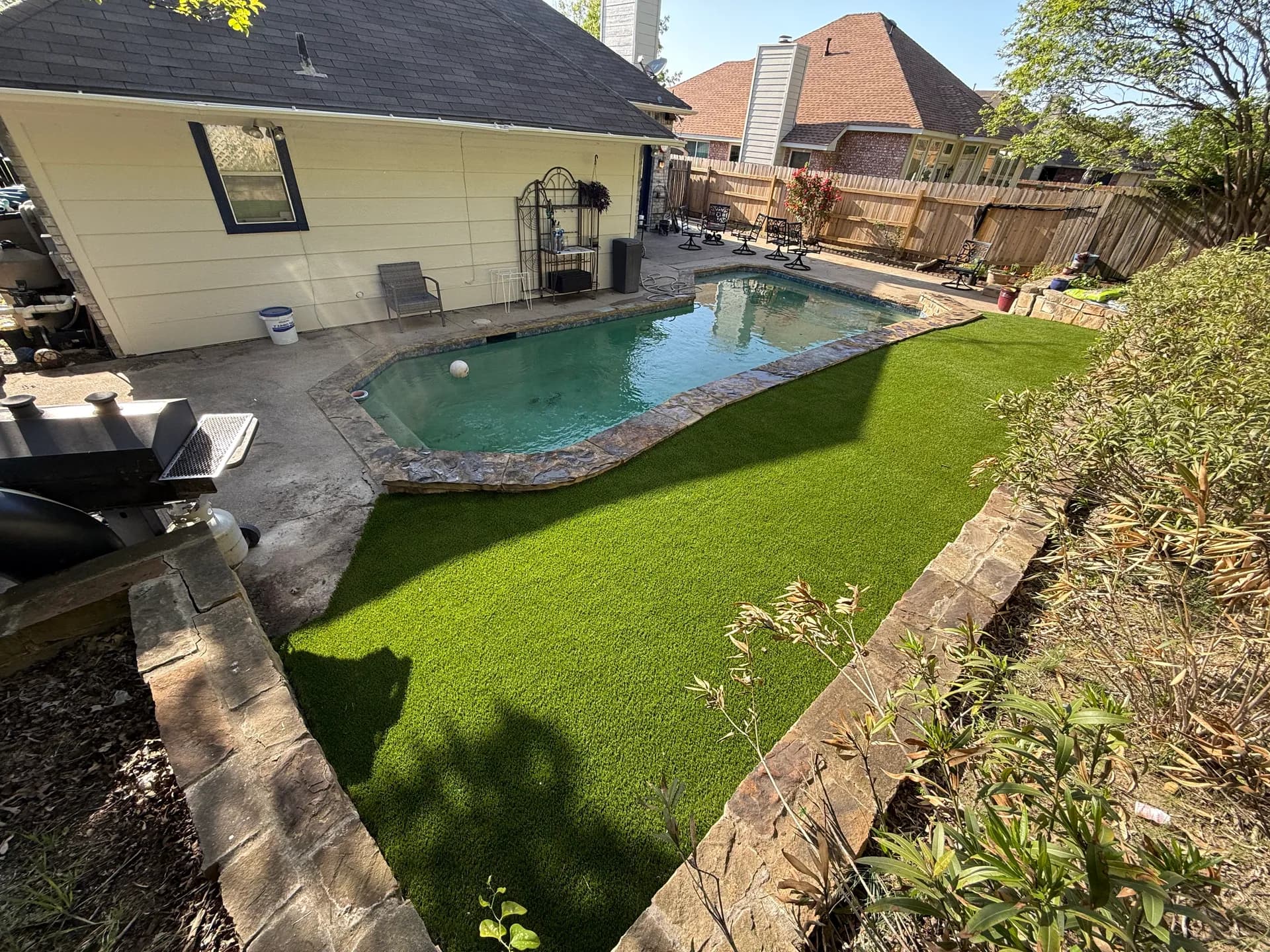
Every summer we get the same call: "My grass is dead again, what do I do?" DFW summers are rough on lawns. Watering restrictions, heat stress, chinch bugs, and hard-packed clay soil conspire to turn even well-maintained yards brown by late July. Artificial turf is the most common alternative — here's what actually works.
Why DFW is Hard on Real Grass
Not a turf-first pitch — just context:
- Summer highs of 100°+ for 30–60 days. Bermuda and St. Augustine both go semi-dormant above ~95°F.
- Watering restrictions. Most DFW cities limit watering to 1–2 days per week during summer.
- Clay soil. Poor drainage, poor root depth, prone to cracking.
- Clay-to-drought cycles. The soil shrinks and expands, stressing roots.
- Chinch bugs and grub. Both thrive in DFW summers.
None of that means you should rip your lawn out. But if you're resodding every 2–3 years, the turf math starts working.
Heat Facts (Because This is the #1 Question)
Yes, turf gets hotter than grass. Depending on conditions, 20–50°F hotter in direct sun. A natural grass lawn at 90°F ambient will measure ~95°F at blade level. Mid-grade artificial turf in the same conditions will measure ~130–140°F.
But:
- New cooling infill technologies (Envirofill, HydroChill, T°Cool) reduce surface temperature by 15–25°F
- Lighter-colored blends (tan + olive vs. dark green) drop another 5–10°F
- Shorter pile heights (1.5" vs. 2.5") run cooler
- Shaded areas (pergola, tree canopy) are close to ambient
Practical translation: mid-afternoon barefoot on direct-sun turf is uncomfortable. Early morning, evening, or under any shade — fine. If your yard is mostly in sun and you want kids barefoot all day in July, you need the cooling infill package.
The Four Grades of Turf (What We Install)
1. Landscape Grade
- 1.5–1.75" pile height
- Polyethylene blade, nylon thatch mix
- Realistic 4-color blend
- 8-year manufacturer warranty typical
- $6.50–9/sq ft installed in DFW
Use case: Front yards, side yards, low-traffic back yards.
2. Pet-Specific Turf
- Shorter pile (1.25–1.5") for easier cleanup
- Antimicrobial backing
- Copper-based infill kills bacteria
- Reinforced drainage base (no puddles or smell)
- 10-year warranty
- $8–11/sq ft installed
Use case: Yards with dogs. Critical — proper drainage base is 80% of the install for pet turf.
3. Play / Family Grade
- 2–2.25" pile for cushion
- Shock pad layer underneath
- Heat-reducing infill
- 10–15 year warranty
- $9–12/sq ft installed
Use case: Kids' play areas, swing sets, any yard where you want the cushion.
4. Putting Green Turf
- 0.5–0.75" super-short pile
- Tournament-roll surface
- Custom contouring (holes, breaks, collars)
- 10+ year warranty
- $18–28/sq ft installed
Use case: Putting greens (obviously) — also a great feature in backyard design.
Why Proper Base Matters More Than the Turf Itself
The turf product you pick matters. The base you don't see matters more. A cheap turf install in Texas fails because of base, not because of the turf.
Correct DFW base:
- Excavate 3–4" below grade
- Lay geotextile weed barrier
- Install 2" compacted decomposed granite or ¼-minus crushed aggregate base
- Grade for ~1% slope to drainage
- Compact with plate compactor
- Shock pad layer (for pet/play grades)
- Turf laid on top, seamed, infilled, brushed
If steps 3–5 are skipped, you get:
- Puddles after rain
- Turf that wrinkles within 18 months
- Smell (pet installs)
- Visible seams that separate
The labor of proper base is ~40% of the install cost. A quote that's significantly cheaper than competitors probably skipped base prep.
Lifespan — Real Numbers
Premium DFW turf installs last:
- Landscape grade: 12–18 years in full-sun yards
- Pet grade: 10–15 years (high-traffic wears faster)
- Play grade: 12–16 years
- Putting green: 12–20 years (low traffic)
The UV-stabilized polyethylene is what degrades over time — direct sun is the limiting factor, not foot traffic.
Cost Savings Math
A 1,500 sq ft backyard turf install runs roughly $10,000–14,000 installed.
Annual real-grass cost for the same yard (water + fertilizer + reseeding + occasional pest treatment): $400–900.
Payback on turf vs. real grass (in direct savings only): 13–20 years. So on pure economics, turf is a wash or close to it over its lifespan.
Where turf actually wins:
- Freed-up summer weekends (no mowing, edging, weeding)
- Usable yard during watering restrictions
- Clean feet, clean paws
- Zero chemicals
- Resale appeal in premium DFW markets
HOA Approval
DFW HOAs used to reject turf universally. That's shifted over the last 3–4 years — most now approve turf in backyards with minor restrictions:
- "Realistic" appearance (dark blends with thatch)
- Hidden from street view
- Professional installation with warranty documentation
Front yards are still usually a no. Backyards, almost always approved with a submission.
What to Avoid
- Rolled-up "starter" turf from big-box stores. You're paying the same labor with a product that fades in 3 years.
- Sand infill alone. Sand compacts, holds heat, and smells with pets.
- Crumb rubber infill. Largely out of favor — gets hot, black color absorbs heat, some environmental concerns.
- Installs without drainage base. This is the #1 failure mode.
Ready for an Estimate?
We install all four grades across DFW — landscape yards, pet-focused setups, play areas, and tournament putting greens. Free on-site measure and a written line-item quote. No pressure, no "today only" pricing.
Ready to Start?
Free on-site estimate — no pressure.
Typical callback under 24 hours across DFW.